

API Docs
When entrest.Config.DisableSpecHandler is false
at generation time, entrest embeds the OpenAPI spec in your generated rest package and registers
GET {BasePath}/openapi.json and GET {BasePath}/docs (an embedded Scalar
UI). With the stdlib handler, GET / (after BasePath is stripped) redirects to /docs.
See Configuration — Base URL and path for how mount paths
affect these URLs.
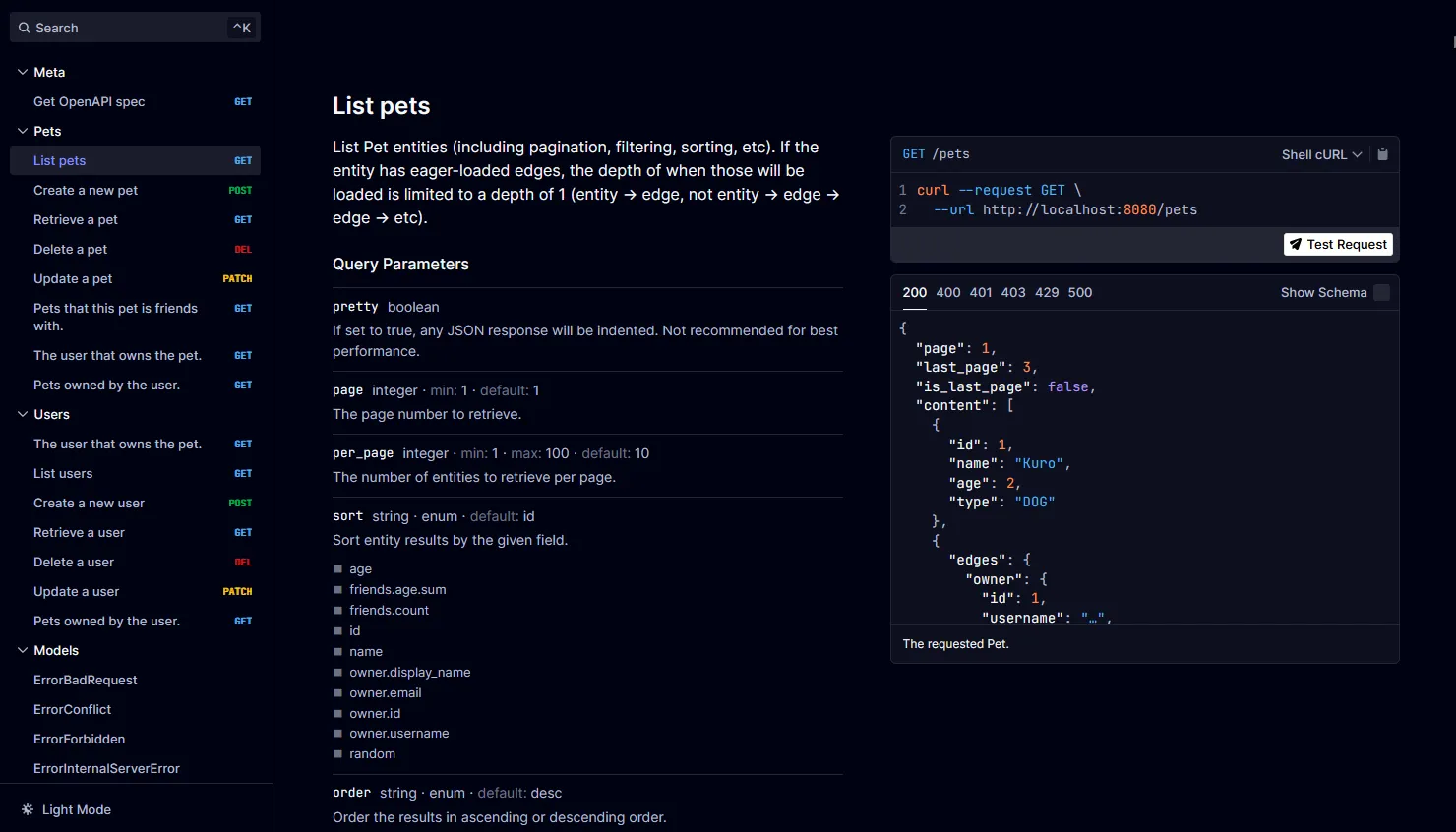
The /docs route is implemented by Server.Docs. It renders a single inline HTML document on each
request and loads Scalar from the jsDelivr CDN — there is no separate static site.
Route registration, spec serving, and DisableDocsHandler are covered in
Configuration — OpenAPI spec endpoint and
API reference docs.
Any OpenAPI viewer that accepts a spec URL can replace the embedded Scalar page:
- Set
DisableDocsHandlertotrueso/docsis not registered by the generated handler. - Keep
/openapi.jsonenabled (unless you serve the spec from another origin). - Register your own
GEThandler that returns a single HTML document. - Point the viewer at
{BasePath}/openapi.json(or an absolute URL if the UI is on another host).
The examples below use RapiDoc and mount custom docs at /v1/docs.
This example serves one self-contained HTML page from Go with fmt.Fprintf, loads RapiDoc from the
unpkg CDN, and overrides component attributes for a focused dark layout.
// [...]
func rapidocDocs(baseURL string) http.HandlerFunc {    return func(w http.ResponseWriter, r *http.Request) {        uri := strings.TrimSuffix(baseURL, "/")
        w.Header().Set("Content-Type", "text/html")        w.WriteHeader(http.StatusOK)        fmt.Fprintf(w, `<!doctype html><html><head>  <meta charset="utf-8">  <meta name="referrer" content="no-referrer">  <script type="module" src="https://unpkg.com/rapidoc@9.3.8/dist/rapidoc-min.js"></script>  <title>Pet Store API</title></head><body>  <rapi-doc    allow-server-selection="false"    bg-color="#18181C"    fill-request-fields-with-example="false"    font-size="large"    layout="row"    load-fonts="false"    mono-font="Consolas, monaco, monospace"    nav-bg-color="#0F0F0F"    nav-hover-bg-color="#1B1B1B"    primary-color="#10B981"    regular-font="Consolas, monaco, monospace"    render-style="focused"    schema-description-expanded="true"    show-curl-before-try="true"    show-header="false"    show-method-in-nav-bar="as-colored-text"    spec-url=%q    text-color="#BBBBBB"    theme="dark"    use-path-in-nav-bar="true"    persist-auth="true"  ></rapi-doc></body></html>`, uri+"/openapi.json")    }}
func main() {    // [...]
    mux := http.NewServeMux()    mux.HandleFunc("GET /v1/docs{$}", rapidocDocs(cfg.BaseURL))    mux.Handle("/", srv.Handler())
log.Fatal(http.ListenAndServe(":8080", mux))}Register the docs route on the same sub-router where you mount the generated API. Set BasePath to
match the mount point so spec URLs stay correct — see
Configuration — Stdlib vs chi.
cfg := &rest.ServerConfig{    BaseURL:            "https://api.example.com/v1",    BasePath:           "/v1",    DisableDocsHandler: true,}srv, err := rest.NewServer(db, cfg)if err != nil {    panic(err)}
r := chi.NewRouter()r.Route("/v1", func(r chi.Router) {    r.Get("/docs", rapidocDocs(cfg.BaseURL))    srv.Handler(r)})http.ListenAndServe(":8080", r)